



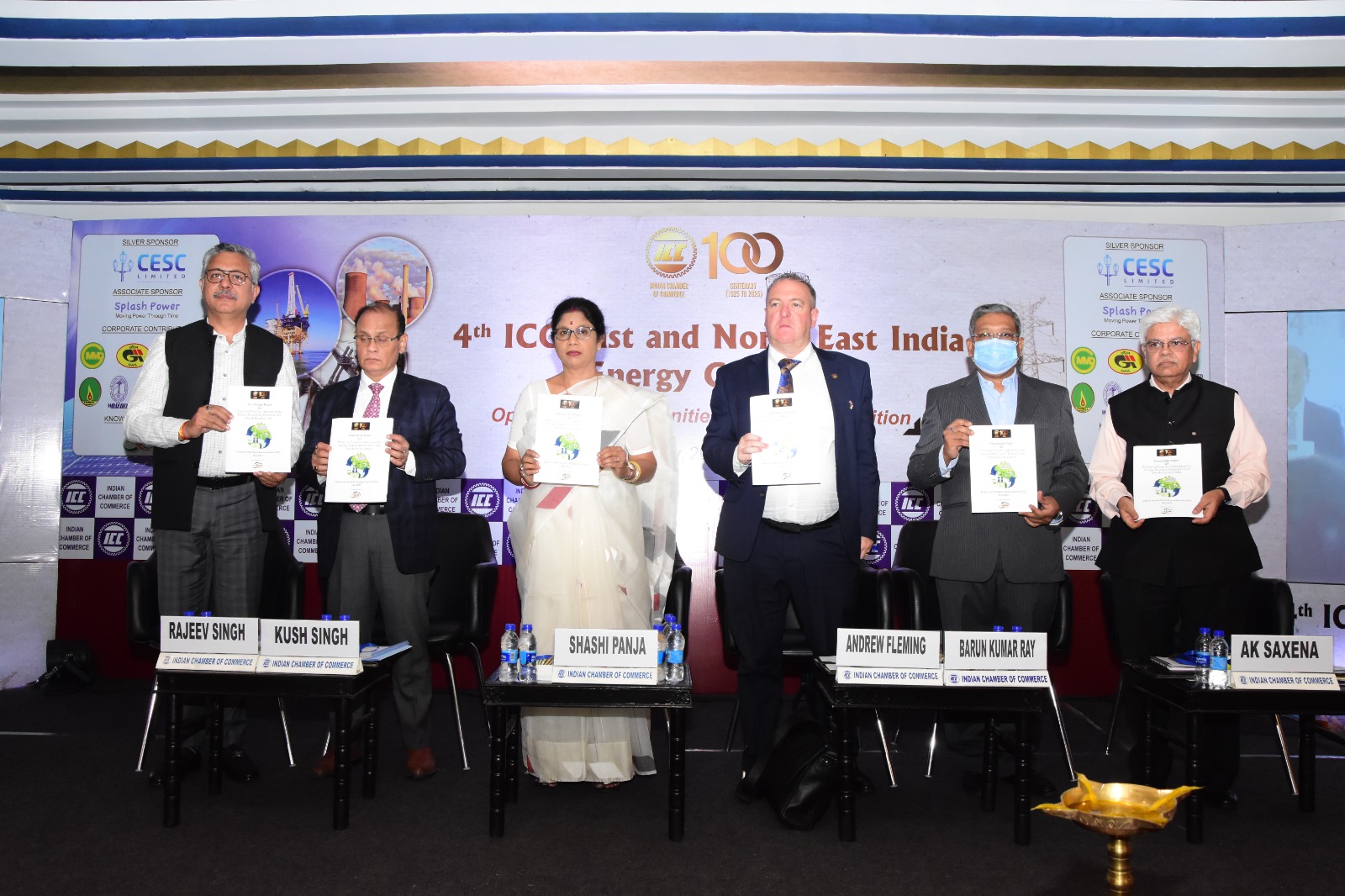

Kolkata, May 22, 2025: West Bengal took center stage in India’s green energy narrative at the Indian Chamber of Commerce’s (ICC) 4th East & North East India Energy Conclave held in Kolkata today. With a focus on accelerating renewable energy adoption and fostering regional collaboration, the event brought together top policymakers, diplomats, and energy experts.
Chief Guest Dr. Shashi Panja, Minister in Charge, Department of Industry, Commerce and Enterprise, Government of West Bengal, announced a series of bold initiatives positioning the state as a national leader in clean energy. “West Bengal is proud to be at the forefront of India’s energy transition, driven by innovation, infrastructure, and industry,” she said.
Key announcements included a ₹16,000 crore, 1,600 MW supercritical thermal power plant by JSW Energy in Salboni and a 125 MW solar PV farm in Goaltore, West Medinipur, funded in partnership with the German Development Bank. The state is also advancing floating solar installations across 30 dams with a combined potential of 3,567 MW, and developing a 2,000-acre industrial park near the Salboni project.
Highlighting the state’s collaboration with The Energy and Resources Institute (TERI), Dr. Panja noted advancements in floating solar, agri-PV, BIPV, battery storage, and electric transport solutions. West Bengal’s growing EV ecosystem includes 318 charging stations and over 68,000 EVs sold by early 2024.
With renewable potential pegged at 44,864 MW across solar, wind, and biomass, West Bengal is also exploring underground coal gasification and has launched Green Hydrogen and Renewable Manufacturing policies targeting 20% renewables by 2030.
Barun Kumar Ray, Additional Chief Secretary, NRES Department, said India’s national goal of 500 GW renewable energy capacity by 2030 is within reach, with 220 GW already achieved. He emphasized the role of eastern and northeastern states in the transition, citing innovative projects like solar cold chains, tidal and pumped storage, and green zones.
British Deputy High Commissioner Andrew Fleming underscored the UK’s support, noting East and North East India’s “immense potential” to lead India’s clean energy transformation. “Our collaboration is already producing tangible results—from EV policy support in Bengal to decentralized energy in the North East,” he stated.
TERI’s Senior Director A.K. Saxena highlighted the region’s untapped 218 GW energy potential and laid out a roadmap including solar parks, pumped storage, microgrids, and smart metering. He also proposed the formation of an East & North East Energy Transition Council.
ICC Director General Rajeev Singh closed the session by emphasizing West Bengal’s rapid strides in green growth. “The state is setting a strong example for inclusive, sustainable development. India’s energy future must—and will—be green,” he said.
The Conclave concluded with a strong call for innovation, investment, and inter-state collaboration to power India’s clean energy future from the East.