



IIT Kanpur Scientists Collaborate with Nobel Laureate David Baker’s Lab on AI-Driven Protein Design

SPREAD THE NEWS

IIT Kanpur Scientists Collaborate with Nobel Laureate David Baker’s Lab on AI-Driven Protein Design  New AI-based method targets key drug receptors linked to cancer and HIV, potentially making early-stage drug discovery faster and more cost-effective  Kanpur, September 4, 2026: Scientists at the Indian Institute of Technology Kanpur (IIT Kanpur) have collaborated with the laboratory of Nobel Prize-winning scientist Prof. David Baker at the University of Washington to develop a new approach for designing small proteins that can target important receptors involved in drug action.  The study, titled “De novo design of miniproteins targeting GPCRs,” has been published in the prestigious journal Nature. The research demonstrates how Artificial Intelligence (AI) can be used to efficiently design novel miniproteins capable of binding to specific G protein-coupled receptors (GPCRs) and influencing their activity.  AI Could Transform Early-Stage Drug Discovery  GPCRs are receptors located on the surface of cells and play a crucial role in transmitting signals from outside the cell to the inside. They regulate several important biological processes and represent one of the largest and most significant classes of targets for modern medicines.  Traditionally, identifying molecules that can effectively target these receptors can require the screening of millions of chemical compounds—a process that can be both time-consuming and expensive.  The new approach takes a fundamentally different route. Researchers first used AI-based computational design to identify proteins most likely to bind to a specific receptor. Only the most promising candidates were then tested experimentally in the laboratory.  By combining computational protein design with targeted laboratory testing, the method could significantly reduce the time and resources required during the early stages of drug discovery.  Targeting Receptors Linked to Cancer and HIV  Using the new technique, the research team designed miniproteins targeting several GPCRs, including CXCR4 and CCR5.  Both receptors are being extensively studied as potential therapeutic targets in cancer and viral infections such as HIV. The ability to design proteins that specifically interact with these receptors could open new avenues for developing targeted therapies.  IIT Kanpur Contributes Cryo-EM Expertise  IIT Kanpur also played a key role in visualising how one of the AI-designed miniproteins interacts with the CXCR4 receptor.  Using cryo-electron microscopy (cryo-EM) at IIT Kanpur’s cryo-EM facility, researchers were able to examine the interaction between the miniprotein and receptor at high resolution. This helped reveal how the designed protein fits onto the receptor and influences its behaviour.  Prof. Arun K. Shukla and Team Make Major Contribution  The research was led by the laboratory of Prof. David Baker, who was awarded the 2024 Nobel Prize in Chemistry.  From IIT Kanpur, Prof. Arun K. Shukla made a major contribution to the study, along with researchers Dr. Ramanuj Banerjee, Manisankar Ganguly, Annu Dalal, Sudha Mishra and Shachie Sinha.  The IIT Kanpur component of the research was supported by the Anusandhan National Research Foundation (ANRF), Department of Biotechnology (DBT), and Lady Tata Memorial Trust.  A Promising Step Toward AI-Designed Medicines  The researchers emphasise that the newly designed miniproteins are not medicines yet. Considerable additional research, safety testing and clinical evaluation would be required before any such protein could potentially reach patients.  However, the study demonstrates the growing potential of AI-driven protein design as a practical tool for drug discovery. By replacing large-scale screening of chemical compounds with computer-guided design followed by focused laboratory validation, the approach could help accelerate the search for targeted protein-based therapies—particularly against receptors that have historically been difficult to target.


New AI-based method targets key drug receptors linked to cancer and HIV, potentially making early-stage drug discovery faster and more cost-effective

Kanpur, September 4, 2026: Scientists at the Indian Institute of Technology Kanpur (IIT Kanpur) have collaborated with the laboratory of Nobel Prize-winning scientist Prof. David Baker at the University of Washington to develop a new approach for designing small proteins that can target important receptors involved in drug action.

The study, titled “De novo design of miniproteins targeting GPCRs,” has been published in the prestigious journal Nature. The research demonstrates how Artificial Intelligence (AI) can be used to efficiently design novel miniproteins capable of binding to specific G protein-coupled receptors (GPCRs) and influencing their activity.

AI Could Transform Early-Stage Drug Discovery

GPCRs are receptors located on the surface of cells and play a crucial role in transmitting signals from outside the cell to the inside. They regulate several important biological processes and represent one of the largest and most significant classes of targets for modern medicines.

Traditionally, identifying molecules that can effectively target these receptors can require the screening of millions of chemical compounds—a process that can be both time-consuming and expensive.

The new approach takes a fundamentally different route. Researchers first used AI-based computational design to identify proteins most likely to bind to a specific receptor. Only the most promising candidates were then tested experimentally in the laboratory.

By combining computational protein design with targeted laboratory testing, the method could significantly reduce the time and resources required during the early stages of drug discovery.

Targeting Receptors Linked to Cancer and HIV

Using the new technique, the research team designed miniproteins targeting several GPCRs, including CXCR4 and CCR5.

Both receptors are being extensively studied as potential therapeutic targets in cancer and viral infections such as HIV. The ability to design proteins that specifically interact with these receptors could open new avenues for developing targeted therapies.

IIT Kanpur Contributes Cryo-EM Expertise

IIT Kanpur also played a key role in visualising how one of the AI-designed miniproteins interacts with the CXCR4 receptor.

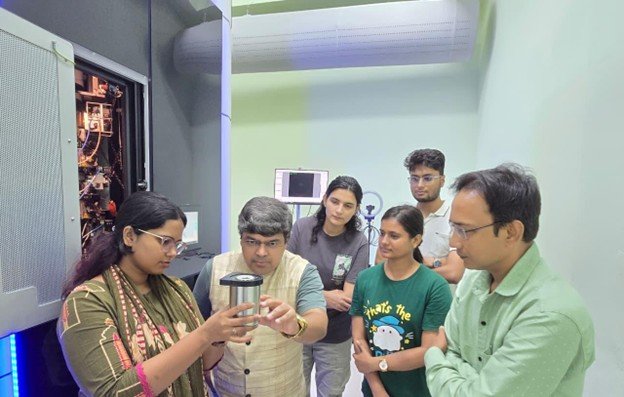
Using cryo-electron microscopy (cryo-EM) at IIT Kanpur’s cryo-EM facility, researchers were able to examine the interaction between the miniprotein and receptor at high resolution. This helped reveal how the designed protein fits onto the receptor and influences its behaviour.

Prof. Arun K. Shukla and Team Make Major Contribution

The research was led by the laboratory of Prof. David Baker, who was awarded the 2024 Nobel Prize in Chemistry.

From IIT Kanpur, Prof. Arun K. Shukla made a major contribution to the study, along with researchers Dr. Ramanuj Banerjee, Manisankar Ganguly, Annu Dalal, Sudha Mishra and Shachie Sinha.

The IIT Kanpur component of the research was supported by the Anusandhan National Research Foundation (ANRF), Department of Biotechnology (DBT), and Lady Tata Memorial Trust.

A Promising Step Toward AI-Designed Medicines

The researchers emphasise that the newly designed miniproteins are not medicines yet. Considerable additional research, safety testing and clinical evaluation would be required before any such protein could potentially reach patients.

However, the study demonstrates the growing potential of AI-driven protein design as a practical tool for drug discovery. By replacing large-scale screening of chemical compounds with computer-guided design followed by focused laboratory validation, the approach could help accelerate the search for targeted protein-based therapies—particularly against receptors that have historically been difficult to target.



SPREAD THE NEWS

More From Author

Star Health Settles 6 Lakh+ Claims Worth Over ₹3,200 Crore in West Bengal

Leave a Reply

Your email address will not be published. Required fields are marked *

Subscribe

Email
The form has been submitted successfully!
There has been some error while submitting the form. Please verify all form fields again.

Recent Post